✦ ✦ ✦
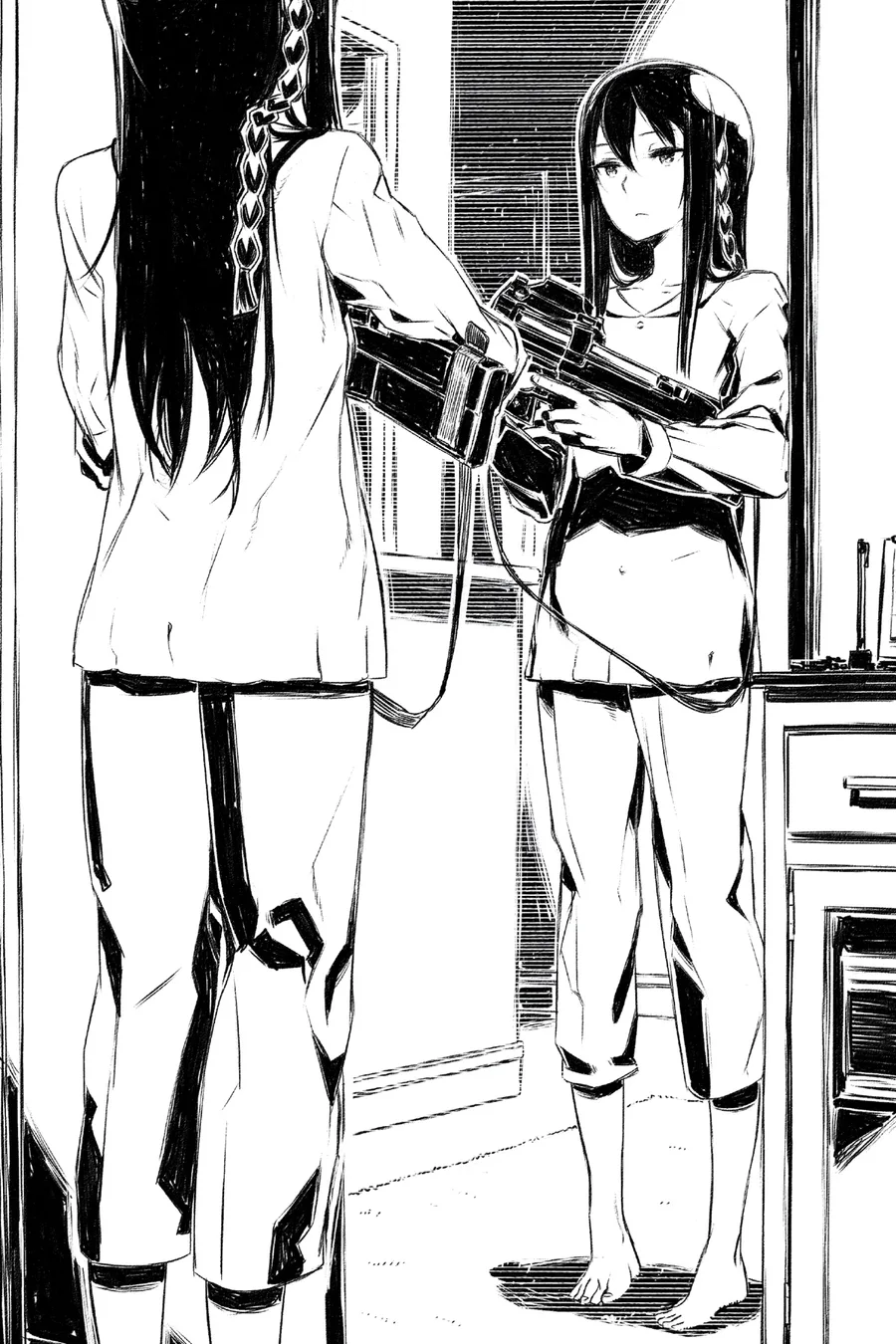
After allowing her eyes a few seconds to adjust to the light, Karen got to her feet. With two barefoot steps, she reached the living room. A clothing rack was next to the standing mirror—and it included one object that was definitely not clothing.
Karen grabbed it and faced the mirror.
“…”
There she saw herself, a grumpy-looking reflection.
A girl with long black hair who stood six feet tall.
She held a black plastic air gun, the same P90 she’d clutched just moments ago—but it appeared much smaller now.
Slowly, Karen’s lips moved. “Squad Jam… Should I even bother? A team PvP battle… I don’t know if I feel up to that…”
✦ ✦ ✦
Karen Kohiruimaki grew up without wanting for anything.
Her parents were originally from Aomori Prefecture before moving across the Tsugaru Strait to Hokkaido, where they started a successful business. Fertility smiled upon them as well, giving them two sons, two daughters, and then, on April 20th, 2006, their last child, Karen.
And so, in a large and comfortable home in the north, it was under the doting eye of her parents and much older siblings that the precious baby Karen grew. And grew. And grew. And grew.
Her growth spurt started in third grade, and by the time she was entering middle school, Karen was already five foot seven. She’d prayed and prayed that her height wouldn’t climb any higher, but God gave no inclination that he was listening.
Instead, she kept growing right through middle school, and now that she was nineteen, she stood at six feet tall. Maybe that wouldn’t be so rare in other countries, but this was Japan.
Her family and close friends understood how Karen felt, so they never mentioned her height, but the ordinary people of society were not so considerate. In middle and high school, she was inundated with requests and invitations from school sports clubs, which she had no real desire to join. She knew when someone was asking her merely because she seemed to have aptitude for the sport, but they didn’t care how she felt about it. She didn’t like that.
When walking in public, she was often described by others as the “giant woman,” and there were surprisingly many who insulted her loudly enough that they intended her to hear it.
No matter how much this upset her, there was nothing she could do about it. Her personal complex about her height changed her during puberty. Little Karen was the very picture of innocence and liveliness, such that she could often be confused for a rambunctious little boy. And now she hardly ever spoke a word to anyone she didn’t know closely, looking inward for her personal pleasures, like reading and listening to music.
She even grew out her hair, hoping it might somehow make her more girlish, but that only resulted in her losing track of when to cut it, and she ended up with so much hair that managing it all in the morning was a pain.
Being tall took a toll on her wardrobe, too. Karen gave up on the idea of feminine fashion and turned to rougher and simpler outfits.
One year ago, Karen graduated high school and moved to Tokyo. Her original plan was to go to a local college, but she’d taken a flyer for one of the most prestigious women’s schools in Japan, which happened to accept her. Her parents had been delighted and arranged for her to stay in a unit at the luxury apartment building where Karen’s eldest sister and her husband lived.
In April of 2025, Karen began life on her own in the big city, hoping that a new place might change something for her.
However, once she started at the prestigious women’s college, she found more of the same.
Given her age, she at least didn’t have to worry about other people teasing her directly anymore, but Karen was otherwise ill-suited to the traditional benefits of the typical college life: trying out new fashions, participating in clubs, going on dates, and so on.
On top of that, this college was an escalator school, meaning most of the students had come up through its attached primary and secondary schools. So she didn’t make any new friends she could truly open up to—although some of that blame was on Karen, who was introverted and didn’t make efforts to reach out to others.
Her daily schedule consisted of attending class, eating lunch alone, listening to music with her earbuds during her break time, returning to the apartment, and spending her free time alone there. The only people she interacted with were her family and friends back home. The only people she spoke to in person were her sister’s family members, when she was invited over for dinner with her niece. Her parents forbade her from taking a part-time job and sent her an ample allowance she couldn’t possibly burn through.
She began worrying that if she didn’t learn to be more social, she’d start to forget how to interact with other people altogether. Then, when she was back home for summer vacation, a particular news article on the Internet caught her eye:
Virtual reality (VR) games make a massive comeback—desire from the public to enjoy a different life is still strong.
VR technology allowed the user to experience total sensory immersion by placing a special device on one’s head that delivered electronic signals to and from the brain. Thus, a VR game used this full-dive technology to bring together multiple players into the same perceived space over the Internet.
Karen was familiar with the concept; nearly everyone in Japan was. The technology had been at the center of an incident that had shocked the entire nation, perhaps the world, when she was in her first year of high school, in November 2022.
Sword Art Online, often known as SAO.
The world’s first VRMMORPG (virtual reality massively multiplayer online role-playing game) had turned into a horrifying nightmare through the malice of its genius developer.
The ten thousand players who first logged in on its launch day found themselves trapped inside the VR world, unable to leave the game of their own accord. Even worse, if their in-game characters died, or if someone attempted to force the device off a player’s head, the device would output microwaves that fried the user’s brain and killed them. It had become a deadly game—literally.
The incident was constant headline news right after the crisis began, but the days kept passing without a solution. Each time a new victim died, everyone heard the familiar and dispiriting refrain of the news cycle. Eventually, the incident simply faded from memory, except for those poor souls whose loved ones were still trapped inside.
Two years later, in November 2024, while Karen was cramming for her college entrance exams, SAO became major news again. This time it was good: The people trapped in the game of death were finally free.
Ultimately, however, four thousand lives had been lost, and SAO was forever known as the deadliest video game in history.
But only those who already hated the idea of VR games actually thought this would be the end of those dangerous things. Even while some players were still captive in SAO, plans for a new device—“It’s safe this time!”—were drawn up and brought to market, along with new games.
The article stated, As of the summer of 2025, the number of VR games continues to rise. The player population is exploding at such a pace that it almost appears as though the traumatic incident of the recent past never happened.
These games provide more real sensory simulations of life than ever before, allowing users to experience a ‘different self,’ but is this really healthy in a humanistic sense? If you want to feel something with all your senses, get off your computer and do what we used to tell children in the old days: Venture outside.
If our children are raised in virtual worlds with no sense of real pain, is it possible that they might go on to commit crimes, the likes of which we adults can never imagine? A much-needed rational debate is waiting to be held.
The article was openly critical of VR games and dripping with the author’s bias and distaste, but it had actually stoked the opposite opinion in Karen.
“A different self…”
Maybe, she’d thought, if I play a different person in a game, I might start conversations with other people more often. Maybe it could work as a kind of therapy or social rehabilitation for real life.
She’d never had any interest in VR before then, but now she had a purpose. When she learned that one of her few friends from back home had VR experience, she went to go ask her about it.
Miyu had said, “Oh my gosh! I’d love to have another friend to play with!”
She’d enthusiastically taught Karen all about it. Soon it became clear that current VR games had none of the danger of SAO. She decided to try it out.